SOLID-STATE METAL MANUFACTURING
Friction Stir Deposition
Build, repair, recycle, and develop metal components through controlled solid-state processes that add, consolidate, extrude, and transform material without melting it.
A Solid-State Path to More Capable Metal Manufacturing
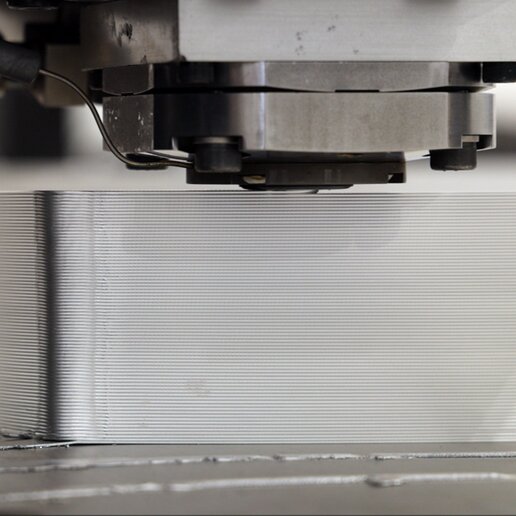
Friction Stir Deposition is a solid-state metal additive manufacturing process in which friction, deformation, pressure, and mechanical stirring are used to extrude and consolidate solid material onto a substrate or previous layer. Unlike melt-based additive processes, FSD does not create a melt pool. It uses a controlled, solid-state process to refine feedstock microstructure, support strong interlayer bonding, limit distortion, and create material properties that can approach those of castings or forgings in qualified applications.
The process also enables new material compositions, refinement of feedstock microstructure, and conversion of qualified feedstocks such as powders, rod, or reclaimed machining chips into consolidated material.
Key Advantages
• Reduce lead times for selected metal components
• Support near-net-shape deposition with material properties approaching those of castings or forgings in qualified applications
• Minimal post-processing, with deposition and machining possible on one motion platform
• Retrofit qualified I-STIR, CNC, and other motion systems
• Integrate motion, monitoring, and process control for process development and qualification
• Support material development and feedstock pathways using rod, powder, and qualified reclaimed material
Four SolidStir™ FSD Technology Pathways
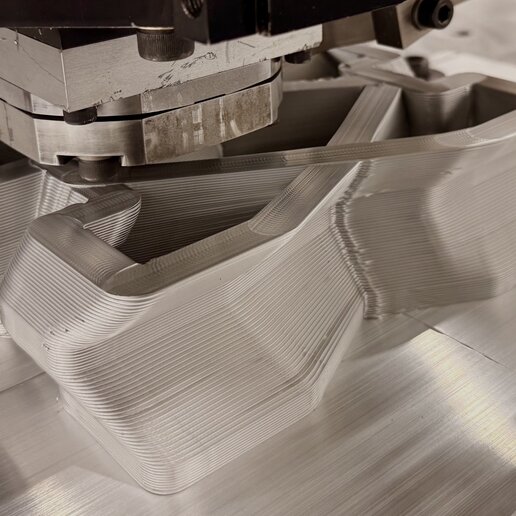
Additive Manufacturing: FSD can build near-net-shape aluminum components layer by layer. The process may be a fit for large or complex components where casting or forging would require long tooling or lead times, or where melt-based additive methods create material utilization, distortion, or performance challenges. In qualified applications, the resulting material properties can approach those of castings or forgings while reducing the amount of material and downstream work needed.
Extrusion: Solid-state extrusion can transform metal feedstock, including rod, powder, machining chips, or other qualified reclaimed material, into consolidated extrudates without melting. Lower processing temperatures, high material utilization, and the potential for complex or graded profiles create opportunities for material development and more efficient manufacturing in qualified applications.
Recycling: FSD can support circular manufacturing approaches by using reclaimed materials such as machining chips or other qualified metal scrap. In suitable applications scrap can be converted on-site into raw material or feedstock for additive manufacturing, creating localized recycling options where the material and process are qualified.
Material Development:The process also creates a platform for developing new alloys, metal-matrix composites, dissimilar-material combinations, and gradient structures. Site-specific alloying and controlled process development may enable material properties and component designs that are difficult to achieve through conventional manufacturing.
Where FSD May Fit in Your Application
Potential application areas for Friction Stir Deposition include building or repairing components for space launch, defense, and marine or Navy ship-repair applications . These environments may benefit from shorter lead times, material efficiency, repairability, production flexibility, and high-integrity metal components.
- Onsite recycling of qualified waste to create wrought material.
- Near-net-shape component manufacturing.
- Additive manufacturing of gradient or laminated material structures.
- Development of additive manufacturing for in-situ composites.
- Solid-state component repair.
- Extrusion of rods, tubes, angles, and wires.
- Upcycling of metal swarf or other qualified reclaimed feedstock.
- Fabrication of metal matrix composites.
- Solid-state material development.
- Lead time reduction for large components.